Showing posts with label Local Insights. Show all posts

Friday, March 2, 2018

Utah's Employment Situation for January 2018

Utah's Employment Situation for January 2018 has been released on the web.

Find the Current Economic Situation in its entirety here.

For charts and tables, including County Employment, go to the Employment and Unemployment page.

Next update scheduled for March 23rd, 2018.


Wednesday, October 25, 2017

Economic Hurdles in Rural Utah

by Mark Knold

Utah is a geographically large state. Based on total area, it is the 13th largest state, implying there is room to spread out. Despite all this space, Utah’s population distribution is quite concentrated. According to the U.S. Census Bureau, Utah is the nation’s 9th most urbanized state. This dichotomy has shaped a state with two economic profiles — one urban, one rural. It can be challenging for a state dominated and prospering within the urban to extend its economic bounty to the betterment of the rural.

What is rural? It depends upon one’s objective behind the question. Most define rural by a visual scan of the landscape. A lot of open land and not many people — rural. Yet economically, the view can be different. An area may look rural, but if the economic vitality of its populace is strongly integrated with a nearby urban area, then this creates a different perspective. The latter is a preference of the federal government — an entity that often makes allocation or distribution decisions based upon economic factors.


No matter how one technically defines rural, the Governor’s Office recognizes a recent dichotomy in Utah’s economic prosperity. Since the Great Recession, Utah has had compelling economic success. Yet, most of this is concentrated in Utah’s urban centers. Portions of Utah’s rural communities are not seeing matching levels of success. Utah’s Lt. Governor recently observed, “Not all of Utah’s communities are full participants in this economic success. Many counties off the Wasatch Front are experiencing challenges.”

In response to this economic disparity, the Governor’s Office has launched the 25k Jobs initiative — an effort for businesses to create 25,000 new jobs in 25 Utah counties by 2020. With this spotlight on rural Utah’s economics, let’s take a look at some of these rural challenges.

To most, jobs deliver their income and means for living sustenance. Therefore, employment, and peripheral variables associated with employment, becomes the strongest proxy for measuring the Utah economy’s health. We will look at Utah’s counties through the lens of employment, unemployment, the labor force and how the industry structure speaks to the underlying performance of these variables.

A profile of job growth becomes a starting point. Economic performance needs to be viewed with a somewhat long lens. The Governor’s 25k Jobs initiative was not born from a short-term disorder, but instead is recognition of weak longer-term fundamentals. To illustrate this perspective, one needs to backdrop the short-term mechanics against the longer-term dynamics.

The County Job Profile chart is an intersection of the short-term trend with the moderate-term. Each county is a bubble, and the bubble size reflects job counts. The chart is divided into four quadrants. The quadrants tell the story of the intersection of the short and moderate-term trends (growth or contraction) and the general health of the county’s economy.


There are two axes of measure. First, the vertical axis represents the short-term. It is the percentage of county job change between 2015 and 2016. Above the horizontal axis is growth — below is contraction.

Second, the horizontal axis measures the moderate-term. It is the percentage of job change over the past five years (2011-2016). To the right of the vertical axis is growth — to the left is contraction. Where a bubble lies is the intersection of the short and the moderate term.

To illustrate, find Beaver County on the chart. Beaver aligns with around -4.0 percent on the vertical axis, and 8.0 percent on the horizontal axis. This says that over the past five years, Beaver County’s job count has grown by 8.0 percent, but over the past year it has contracted by around 4.0 percent. This implies that Beaver County’s economy may be slipping a bit. A one-year view would imply a problem. A longer-term view places this short-term setback against a broader perspective of overall prosperity.

The quadrant of concern is the Contracting quadrant. These economies have contracted over both the most recent year and the past five years. No matter how one wants to define rural as outlined above, all of these contracting counties identify as rural.

In-county jobs alone are not the complete picture. For example, a large percentage of Morgan County’s residents commute to Weber or Davis counties for work. If jobs are not being germinated in Morgan County, the county and its population can still prosper from its ties with the urban area.

An additional way to look at the economy is through the lens of the labor force. The labor force consists of those 16-years and older who are either working or looking for work. It is based upon where people live, not where they work. A worker living in Morgan County will be represented in Morgan County on the following chart (County Labor Force Change); yet, if they work in Weber County, their job is represented in Weber County on the prior chart. Adding this perspective helps to round out a county’s profile.

The structure of the County Labor Force Change graphic is the same as the prior chart. The area of vibrancy is the upper-right quadrant where the labor force is increasing. The quadrant of labor force contraction is the lower left. A decline in the labor force occurs when people become discouraged and leave the labor force — yet stay in the county, or when people leave the county altogether. Either way, a decline in the labor force signals a fundamental negative in the economic trend.

Depending upon the variables measured, a gain in one and a decline in another can both be positive. Job growth and an unemployment decline are both positive. To associate the positive with low unemployment, the quadrant message on the Unemployment Rate chart has been transposed.

Every month an unemployment rate is calculated for Utah and each of its counties. A county’s unemployment rate can be measured against the Utah statewide average unemployment rate. In the following graphic, county rates are mathematically compared against the statewide rate (seasonally adjusted), recorded and then summed across time.

For example, if a county’s unemployment rate is 5.5 percent and the statewide rate is 4.0 percent, then that county’s difference for that month is 1.5. If a county’s rate were to be 3.5 percent against the statewide rate of 4.0 percent, then the difference is -0.5. These monthly differences are tallied and summed. A high score speaks to a consistent and persistent unemployment rate above the statewide average. In other words, these are counties with a continuous environment of high unemployment.

The horizontal axis is a measure since 2000 and the vertical axis a measure since the beginning of the Great Recession (2008). The axis intersection is not at zero to isolate the “concern area” within the upper right quadrant. The statewide average is consistently close to the Salt Lake County average, so a sizeable number of counties will have sums slightly above the statewide average; yet, this doesn’t imply an unemployment problem. But the non-zero intersection is utilized to emphasize the counties that do have an outstanding unemployment disparity.

Across these various charts, a common group of rural counties emerge in the weak quadrant. These include Carbon, Emery, Garfield, Piute and San Juan counties; with Duchesne and Uintah hanging on the edge. There is a common theme that surrounds this grouping and it centers upon low economic diversity.

An economy’s ability to be consistently positive has a strong foundation in a diverse mix of industrial employment. Think of it in terms of “not putting all your eggs in one basket.” Economic diversity is spreading jobs across many baskets. Diversity is desirable because the overall economy is not dominantly influenced by one or a handful of industries whose poor performance weighs upon the whole.

A Hachman Index is an evaluation tool measuring to what degree an economy may or may not have all its eggs in one basket. In the Hachman Index, a measure of 1.0 means your eggs are well distributed across many industries. Conversely, numbers approaching zero point to a high concentration in one or a handful of industries.


Many of the counties that score low on the previous charts are the same ones on the lowest tier of the following Hachman Index chart. This chart represents the placement of economic diversity upon employment change of the past five years. A county will be placed high or low (vertical axis) on the chart depending upon its Hachman Index score. It will align right or left (horizontal axis) depending upon its five-year employment change. Metropolitan counties have higher economic diversity than rural counties — placing them higher on the chart. They are also further to the right on the chart, showing stronger employment growth. There can be individual exceptions, but the general theme is that lack of economic diversity is a foundational impediment to economic viability. Industrial diversity, though difficult to artificially induce, is a desired remedy to counter sluggish economic performance.

Lack of diversity does not mandate a poor economy. A reproduction of this chart five years ago would have placed Uintah and Duchesne counties still low on the chart, but their five-year growth rates would have been off the chart, needing arrows to point out beyond the chosen 40 percent horizontal axis limit.

Those economies are dominated by energy production. When energy prices are high, their economies can soar. When energy falters, they often do likewise. They are striking examples of economic outcome being determined by a dominant industry.

In summary, there is a dichotomy within the Utah economy between urban and rural. The urban economies are diverse and, therefore, more economically balanced; while many rural economies are not. With some rural counties the economic distinction is not a wide divide; but in the rural counties where the divide is pronounced, the underlying theme is often a low level of economic performance.

Tuesday, February 14, 2017

Better, Faster, Smarter... Check out our new website design!


Go to: JOBS.UTAH.GOV/WI to check it out

Information is the treasure of the current age. The instant access to information since the advent of the Internet has transformed societies in ways that thousands of years prior had not. Information can lead to knowledge, and — with increased knowledge — better efficiencies and way of life. If information is vital, then the presentation of information has also risen to a prominent level. With this, the Utah Department of Workforce Services has made some organizational improvements to its economic webpages. Various economic data categories are not mutually exclusive, but we made an effort to compartmentalize economic data for a better organizational display and navigation. We also added a new feature area that taps into various national data elements and measurements from the Federal Reserve Economic Data (FRED), the database of the Federal Reserve Bank of St. Louis. FRED’s added value is national — and Utah — economic indicators. More on FRED’s contribution below.

Depending on the subject, economic data can be categorized as either broad or specific. For example, the demographic makeup of an area and how that impacts an economic structure is a broad-subject approach. Conversely, a current monthly snapshot of the Utah economy, its job growth and unemployment rate is a more specific observation. Our economic webpage has four “portals” through which to “categorize” and search for information. One portal is broad, while the other three are more specific in nature.

Topic Portals

The monthly employment profile just mentioned is a specific topic and gets its own “portal,” entitled Employment Update. Here, the most current Utah economic performance can be explored and summarized. The information found here is what often gets cited in the local news media in reference to the current Utah job performance and unemployment rate.

The second specific “portal” is labeled Local Insights. This is a quarterly profile of the Utah economy down to a county level. Each county is summarized with its own economic performance, including job growth, unemployment rate, housing starts, taxable sales and other profile variables. The common theme here is a county-specific approach.

The third specific “portal” is Reports and Analysis. Workforce Services’ economic forte is the labor market. Things over and above the everyday reporting on the labor market are presented here. Sometimes we do special economic studies, other times we will report on specific economic groups within the labor force, like women or veterans. Anything we do that is not an often repeated or ongoing report are grouped here.

The final “portal,” and possibly the one that will be most used, is labeled Economic Data. The core of our data collection and analysis is concentrated here. Employment data, occupational data, wage information and demographic profiles are just some of the major economic themes found in this area.

FRED's on site

As mentioned earlier, we have added an economic indicator area tapping into FRED, which is a massive compilation of economic data from various sources — primarily government statistical agencies, but also some nongovernmental organizations. Workforce Services economists have gone through the list and selected a handful of the most useful data series for gauging the performance of Utah’s macro economy and gaining insights into expected trends. Utah functions within the national economy, so the national economic indicators profiled here are intended to also be guiding influences on the Utah economy. These indicators include composite indexes; a recession probability indicator; leading indicators, such as construction permits and the yield curve; coincident indicators, such as real GDP and employment; and price indicators, such as the consumer price index, regional housing prices, and oil and gas prices. Each chart has a detailed description of what the data represent and how they may be useful.

Keeping relevant with the fast-changing pace of the Internet and data presentation is our goal at Workforce Services. We hope these changes help to better present our broad package of economic data offerings.

Friday, January 29, 2016

Educational Profile of the Southeast Region

Scott Smith, Regional Economist


The American Community Survey (ACS) is a statistical survey administered by the U.S. Census Bureau. It regularly gathers information previously contained only in the long form of the decennial census, such as educational attainment, income and housing characteristics by age and sex. Sent to 3.54 million addresses annually, it is the largest survey (other than the decennial census) that the Census Bureau administers.

The ACS offers insights how the country’s workers of varying educational attainment are distributed and how they are compensated.

As a point of reference, on average, U.S. workers who possess less than a high school diploma earn $19,954. High school graduates earn $27,868. Workers who earned an associate’s degree or attended college earned $33,988. College graduates earn $50,515. Recipients of graduate degrees make $66,944.
Nationally, men make more than women. For example, women earn between 32 and 34 percent less than males with equivalent educational background. Some, but not all, of this difference can be explained by a significant proportion of women who choose part-time employment.

The ACS also maps the composition of the labor force by highest educational attainment. Nationally, roughly 12 percent of the 25-year-and-older population has not graduated from high school. Almost 27 percent of the population has a high school diploma while 31 percent has advanced to an associate’s degree or has attended university. A little more than 30 percent has a bachelor’s degree.

What follows is a comparison of the population of the counties in the Southeast Region against the national statistics.

Grand County

On average, Grand County residents who possess a high school diploma earn $31,396. Workers who have earned an associate’s degree or attended college earn $23,051. College graduates earn $31,174. The reader should regard these median income statistics with some skepticism; analysts speculate that they are a product of large sampling errors. Holders of graduate degrees substantially out earn bachelors, $53,000 compared to $31,174.

Workers in Grand County earn 70 percent of the U.S. median. With respect to gender, women in the county earn 65 percent of men’s wages, while the analogous U.S. figure is 72 percent; however, these figures are suspect. This is evidenced in the ACS reports that women with less than a high school education earn 195 percent of the equivalent man’s income, while women who hold bachelor’s degrees only make 37 percent.

High school graduates in Grand County earn 113 percent of the U.S. median. Men earn 104 percent of the U.S. median for men, while women earn 106 percent of the U.S. median for women. Grand County residents who hold an associate’s degree or have attended college make 68 percent of the U.S. average. Men earn 61 percent of the U.S. median, while women earn 66 percent. College graduates in Grand County make 62 percent of the U.S. median. Men earn 66 percent of the U.S. median for men; in contrast, women earn only 32 percent of the U.S. median for women. Recipients of graduate degrees earn 79 percent of the U.S. median. Men make 65 percent, while women make 60 percent of their respective median.

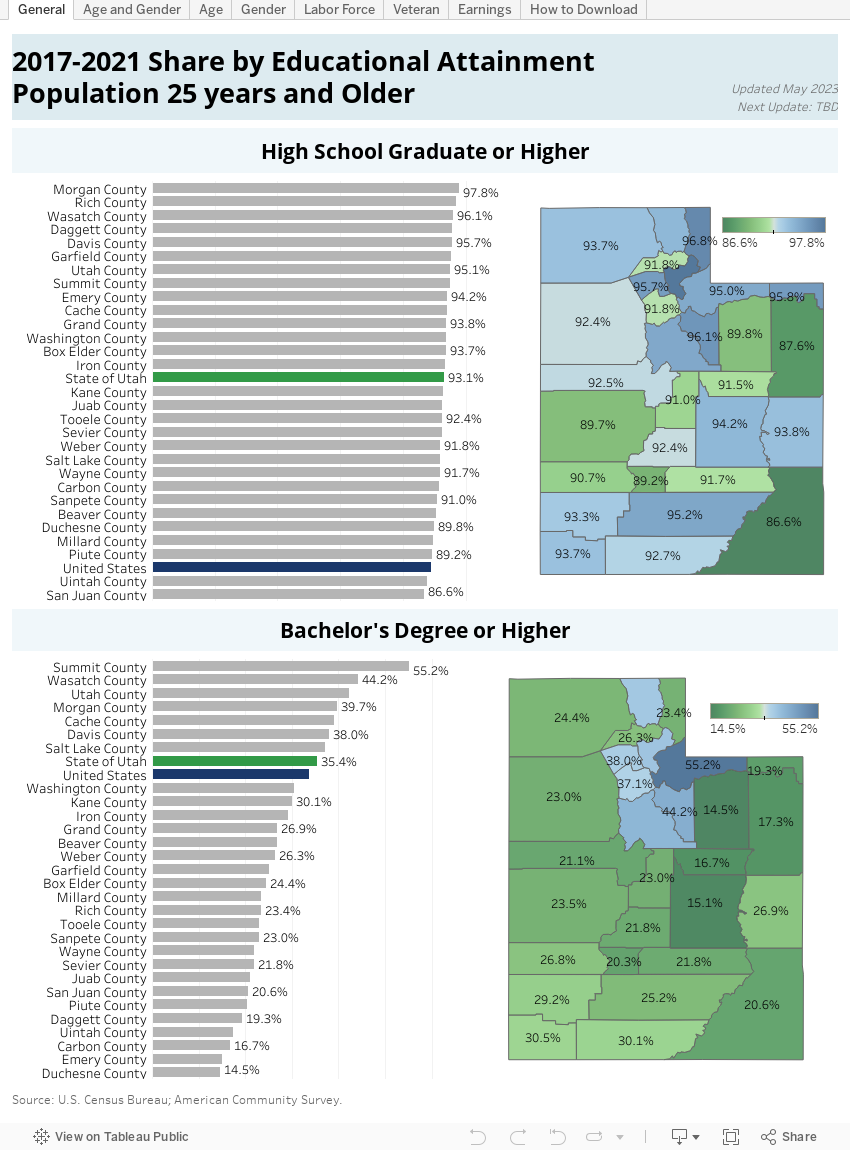
Grand County’s population differs from the U.S. by educational attainment. Almost 43 percent of the county’s population reports holding an associate’s degree or having attended college — the national number is 31 percent. Only 22 percent of the county’s population holds at least a bachelor’s degree — the national figure is 31 percent.

San Juan County 

San Juan County who possess less than a high school diploma earn on average $18,906. High school graduates earn $24,705. Workers who have earned an associate’s degree or attended college earn $28,333. College graduates earn $41,354. Recipients of graduate degrees make $49,694.

Workers in San Juan County earn 82 percent of the U.S. median. With respect to gender, women earn 60 percent of men’s wages, while the analogous U.S. figure is 72 percent. It is interesting to note that women in San Juan County with college educations perform better than their national counterparts. Women with bachelor’s degrees earn 72 percent of their male counterparts’ income, while women who hold graduate degrees earn 90 percent of their male coworkers’ income. High school graduates in the county earn 89 percent of the U.S. median. Men earn 97 percent of the U.S. median for men, while women earn only 64 percent of the U.S median for women. San Juan County residents who hold an associate’s degree or have attended college make 83 percent of the U.S. median. Men earn 92 percent of the U.S. median, while women earn 81 percent of their respective statistic. College graduates in San Juan County make 81 percent of the U.S. median. Men earn 72 percent of the U.S median for men; in contrast, women earn 77 percent of the U.S. median for women. These statistics are suspect due to large sampling error. Recipients of graduate degrees earn 74 percent of the U.S. median. Men make 64 percent of the median; surprisingly, women make 86 percent of the median for women with graduate degrees.

San Juan County’s labor demographics differ markedly from the nations because of participation rates and educational attainment. For individuals with less than a high school education, more than 7.9 percent of the county population is not in the labor force — the U.S. number is 4.7 percent. More than 15 percent of county residents with a high school diploma do not participate in the labor market. The analogous national number is a little more than 7 percent. The county also has less college graduates than the nation as a whole — 19 percent of the county’s population possesses a bachelor’s degree of higher (the national figure is 31 percent).

Wednesday, November 4, 2015

Reviewing the 2012 Agricultural Census for the Southeast Region

Scott Smith, Regional Economist


The 2012 Census of Agriculture is just that — a census. It is an attempt to count an entire population and generally does not use sampling or statistical techniques to make conclusions about the population. It is conducted every five years and includes all farm operators regardless of whether farming is their primary or secondary occupation. Operators and hired laborers are combined for a total count. There can be a maximum of three operators per farm, but labor hired on a contract basis is not covered.

The Southeast Region agriculture is largely devoted to the livestock business, this by raising cattle or growing hay. There is also some wheat farming worth noting in San Juan County. 2012 net cash income per farm for Grand County was -$3,725. The analogous figure for San Juan County was -$1,522. The vast majority of farms have annual total sales less than $250,000.

Southeast Region 2012 employment was 1,679 jobs according to the census (this number may slightly differ from other data presented because of confidentiality issues). The state’s unemployment insurance data suggests that a very small number of these jobs generate the income or possess the duration to be considered “full time” employment in the urban sense. Further data indicates that most farmers and ranchers are sole proprietors (regardless of how they are organized for tax purposes). Finally, a comparison of the other sources and the census figures shows that most individuals involved in agriculture have their primary job in other sectors of the economy.

The size and composition of the agricultural workforce has changed markedly over time. In 2002, the total Southeast Region agricultural workforce was 839 workers, of which 40 percent was hired labor. That total increased by 112 percent to 1,776 in 2007, yet the share of hired laborers fell to 16 percent in the same period (although this statistic may be skewed downward because of reporting issues). In 2012, the agricultural employment count fell 5 percent to 1,679 and the share of hired labor increased slightly to 20 percent.

In 2002, the labor cost per worker (as defined by dividing annual labor expense by the hired workforce) was $1,270. In 2007, the cost had fallen by 33 percent to $850. In 2012, this number had increased by 15 percent to $980. In contrast, inflation increased by 15 percent and 9 percent as of 2007 and 2012, respectively.

There were 325 principal operators in the Southeast Region in 2002 (the statistics refer to “principal” operator and therefore will not agree with other totals). The number of operators increased to 848 in 2007, which is an astounding 161 percent increase. The count dropped slightly to 827 in 2012. The share of operators relying on other sources of employment has been remarkably constant. In 2002, the proportion was 41 percent. It dropped slightly to 40 percent in 2007. The share then increased to 46 percent in the 2012 Census.

Analysts are unable to convincingly explain the employment patterns with income statistics. One would expect to observe the number of operators falling in concert with the decline in income. Similarly, one should expect that operators would seek other sources of employment when income declines. Farm income per operator was $2,723 in 2002, and then decreased 300 percent to -$2,085 in 2007. In 2012, income per operator declined another 19 percent with a total of -$1,738.