Showing posts with label Economist--Eric Martinson. Show all posts
Showing posts with label Economist--Eric Martinson. Show all posts
Thursday, March 27, 2014
County seeks Uintah’s feedback on new Book Cliffs road study
Grand County Council unanimously approved a letter asking the Uintah County Commission to perform a feasibility study for building a paved road linking the Vernal area to the Moab area. Historically, proposals to pave a road from Vernal to Moab have hit dead ends. Let’s keep in mind that this is still just a feasibility study, this doesn’t necessarily imply that the overall consensus for building a road is favorable, but it is a sign that interest in seriously reconsidering this issue may be gaining. Times Independent


Tuesday, October 8, 2013
Eastern Region Initial Weekly Unemployment Insurance Claims
A full 13 weeks of third-quarter initial weekly unemployment insurance (UI) claims data have come in for Utah’s eastern counties – Duchesne, Carbon, Emery, Grand, San Juan and Uintah. Initial weekly UI claims for Daggett County were not provided because of its relatively small workforce. The third-quarter weekly average of county UI claims are provided for each year from 2007 to 2013.
Of the six eastern counties provided, two (Carbon and Emery) have lower average weekly UI claims in third quarter of 2013 compared to 2012. Two counties (Duchesne and Grand) show about the same average level of third-quarter UI claims. The remaining two counties (San Juan and Uintah) show higher average third-quarter UI weekly claims in 2013 than in 2012. All six counties in 2013 have lower average weekly claims than during the Great Recession highs, though Uintah County average third-quarter initial weekly claims have been increasing over the last three years.
Of the six eastern counties provided, two (Carbon and Emery) have lower average weekly UI claims in third quarter of 2013 compared to 2012. Two counties (Duchesne and Grand) show about the same average level of third-quarter UI claims. The remaining two counties (San Juan and Uintah) show higher average third-quarter UI weekly claims in 2013 than in 2012. All six counties in 2013 have lower average weekly claims than during the Great Recession highs, though Uintah County average third-quarter initial weekly claims have been increasing over the last three years.
Grand County’s Highly-Seasonal Labor Economy
Eric Martinson, Economist
One of the great aspects of Utah’s overall economy is in its diversity. Utah’s economy has consistently been able to mirror the nation’s economic diversity, with manufacturing in the northern Wasatch Front and Wasatch Front regions, oil and gas in the Uintah Basin, coal mining in Castle Country and the tech hub of Utah County. Another important industry which capitalizes on Utah’s diverse geographical landscape is tourism and recreation, from skiing in the winter in the Wasatch Mountains to spring-through-fall recreation in red rock country. Home to the ultimate red rock experience in Moab, Arches and Canyon Lands (among other recreational hotspots), Grand County is a mecca for those wishing to recreate, which occurs mostly during the warmer months of the year. The unique nature of this local economy provides and interesting dynamic in its highly-seasonal labor market activities. I have created three visualizations illustrating the degree of Grand County’s seasonality in terms of employment activity.
One of the great aspects of Utah’s overall economy is in its diversity. Utah’s economy has consistently been able to mirror the nation’s economic diversity, with manufacturing in the northern Wasatch Front and Wasatch Front regions, oil and gas in the Uintah Basin, coal mining in Castle Country and the tech hub of Utah County. Another important industry which capitalizes on Utah’s diverse geographical landscape is tourism and recreation, from skiing in the winter in the Wasatch Mountains to spring-through-fall recreation in red rock country. Home to the ultimate red rock experience in Moab, Arches and Canyon Lands (among other recreational hotspots), Grand County is a mecca for those wishing to recreate, which occurs mostly during the warmer months of the year. The unique nature of this local economy provides and interesting dynamic in its highly-seasonal labor market activities. I have created three visualizations illustrating the degree of Grand County’s seasonality in terms of employment activity.
Tuesday, March 19, 2013
San Juan Highlights
San Juan county remains one of the counties hit hardest by the recent recession. Total nonfarm employment year-over growth has been negative in San Juan county since the summer of 2011. San Juan county’s total employment for third quarter 2012 fell by 111 jobs, a 2.6 percent year-over-year decline. Recovery has been tough for this corner of the state, but there were some bright patches during the third quarter.
Professional and business services added 37 jobs in the third quarter compared to the same quarter of 2011, representing a 22.8 percent increase. Educational, health and social services also grew by 8.9 percent, or 50 jobs. Construction, accommodation and food services, and retail were some industries that saw the biggest third quarter declines in terms of employment. Government, too, shed 46 jobs.
Construction data from the Bureau of Economic and Business research at the University of Utah tells the same story. Construction is stalled as dwelling permits are at 4 percent change year-over-year and permit-authorized construction values dropped 4 percent year-over-year. Also, taxable sales data from the most recent Utah state tax commission report shows consumer spending is actually up 17.5 percent.
Read more about San Juan and Southeast Utah including the Castle Country area in the latest issue of Southeast Local Insights.
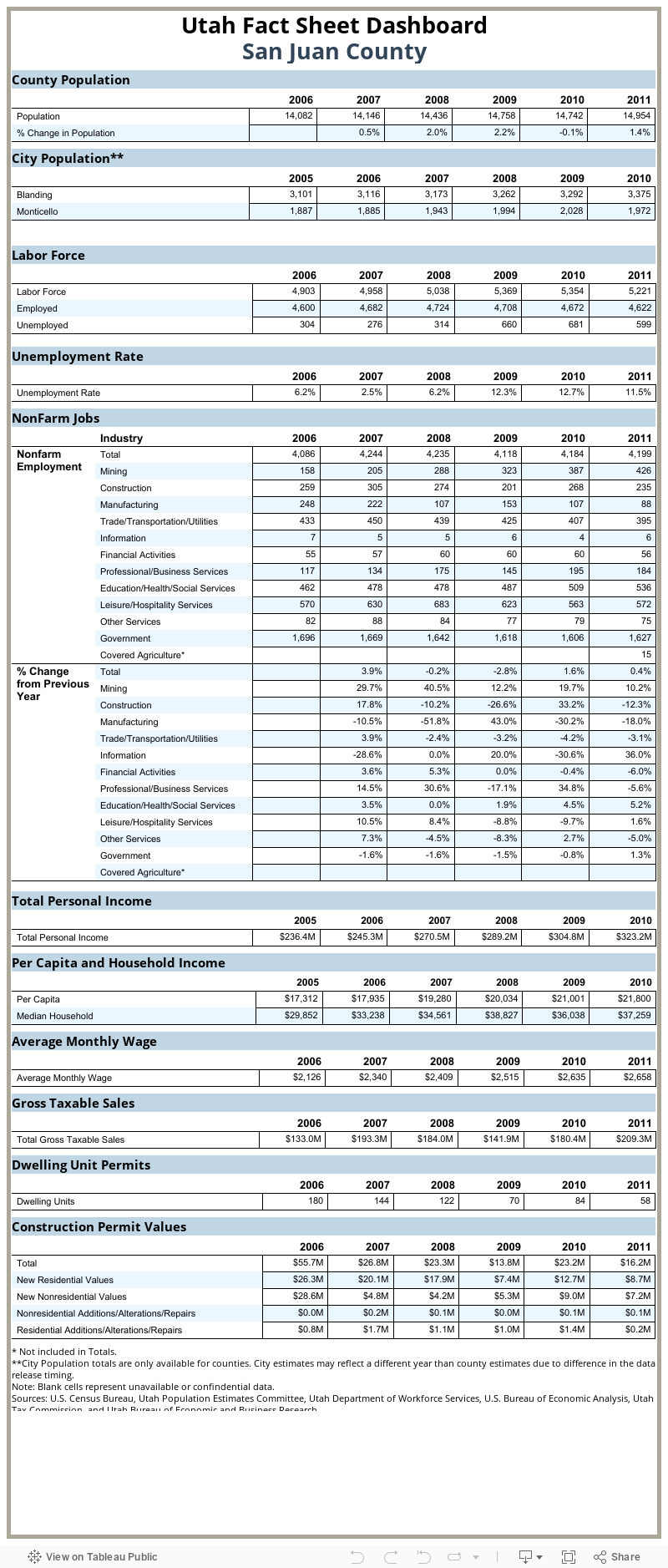 Access San Juan’s county eProfiles here: San Juan eProfiles
For more county eProfiles, see here
Professional and business services added 37 jobs in the third quarter compared to the same quarter of 2011, representing a 22.8 percent increase. Educational, health and social services also grew by 8.9 percent, or 50 jobs. Construction, accommodation and food services, and retail were some industries that saw the biggest third quarter declines in terms of employment. Government, too, shed 46 jobs.
Construction data from the Bureau of Economic and Business research at the University of Utah tells the same story. Construction is stalled as dwelling permits are at 4 percent change year-over-year and permit-authorized construction values dropped 4 percent year-over-year. Also, taxable sales data from the most recent Utah state tax commission report shows consumer spending is actually up 17.5 percent.
Read more about San Juan and Southeast Utah including the Castle Country area in the latest issue of Southeast Local Insights.
For more county eProfiles, see here
Monday, November 5, 2012
Small Private Sector Employers Dominate the Southeast Utah Employment Landscape
Evaluating employment in Utah according to firm size provides a deeper understanding of who employs Utah’s workforce, which in turn can provide an interesting perspective into how different size firms operate in any economic environment. Here, definitions of small, medium, and large firms are provided by the Bureau of Labor Statistics: small is any business that employs 1-49 individuals; medium businesses employ 50-499 individuals; large firms employ at least 500 individuals.
At the state level, 95 percent of private sector firms are small employers and are responsible for 35 percent of all private sector employment in the state. On the other hand, while large employers represent only less than one percent of all private sector firms in Utah (0.3 percent to be exact), these large firms are responsible for 30 percent of total employment in the state. To what extent may this be the case in other areas of the state? Do large employers dominate the landscape outside of the large metropolitan areas?
In the Castle Country Economic Service Area (comprised of Emery and Carbon counties), for example, 82 percent of private sector employers are small firms. Thirteen percent are mid-size firms and five percent are large firms. While just five percent businesses are large firms, these five percent are responsible for one in five private sector jobs in the Castle Country region. This is more or less in line with state-level breakdown.
In the Southeast ESA (Grand and San Juan Counties), 89 percent of private sector employers are small firms, 7 percent are mid-size firms, and just fewer than 4 percent are large firms. Interestingly, whereas large private sector employers were responsible for 20 percent of employment in Castle Country (or 30 percent at the state level), large employers in the Southeast region are responsible for just 5 percent of total private sector employment. In the Southeast, the small employer clearly dominates, employing over 70 percent of total private sector employees. In fact, firms that employ between 25 and 49 employees, on a twelve-year average, make up just under half of all private sector employment in the Southeast region.
Interested in the dynamics of employer size in your region? The upcoming 2012-13 Winter Edition of Local Insights will highlight these and other details regarding employment by firm size.
 |
| Click graph to enlarge |
At the state level, 95 percent of private sector firms are small employers and are responsible for 35 percent of all private sector employment in the state. On the other hand, while large employers represent only less than one percent of all private sector firms in Utah (0.3 percent to be exact), these large firms are responsible for 30 percent of total employment in the state. To what extent may this be the case in other areas of the state? Do large employers dominate the landscape outside of the large metropolitan areas?
 |
| Click graph to enlarge |
In the Castle Country Economic Service Area (comprised of Emery and Carbon counties), for example, 82 percent of private sector employers are small firms. Thirteen percent are mid-size firms and five percent are large firms. While just five percent businesses are large firms, these five percent are responsible for one in five private sector jobs in the Castle Country region. This is more or less in line with state-level breakdown.
 | |
| Click graph to enlarge |
Interested in the dynamics of employer size in your region? The upcoming 2012-13 Winter Edition of Local Insights will highlight these and other details regarding employment by firm size.
Friday, June 29, 2012
Moab Area Business Enhancement Summit

An economic update presentation given for the Moab Area Business Enhancement Summit is available online here.
Wednesday, April 11, 2012
Tailings cleanup to be scaled back due to funding issues
Portage Inc., the Idaho Falls-based company that was recently awarded a five-year contract for the Uranium Mill Tailings Remedial Action project, has announced that cleanup work at the former Atlas Uranium mill site north of Moab will be scaled back from a year-round effort to nine months annually for the next five years, U.S. Department of Energy officials said this week. Moab Times - Independent
Subscribe to:
Posts (Atom)