Showing posts with label Careers/Education. Show all posts

Friday, January 29, 2016

Educational Profile of the Southeast Region

Scott Smith, Regional Economist
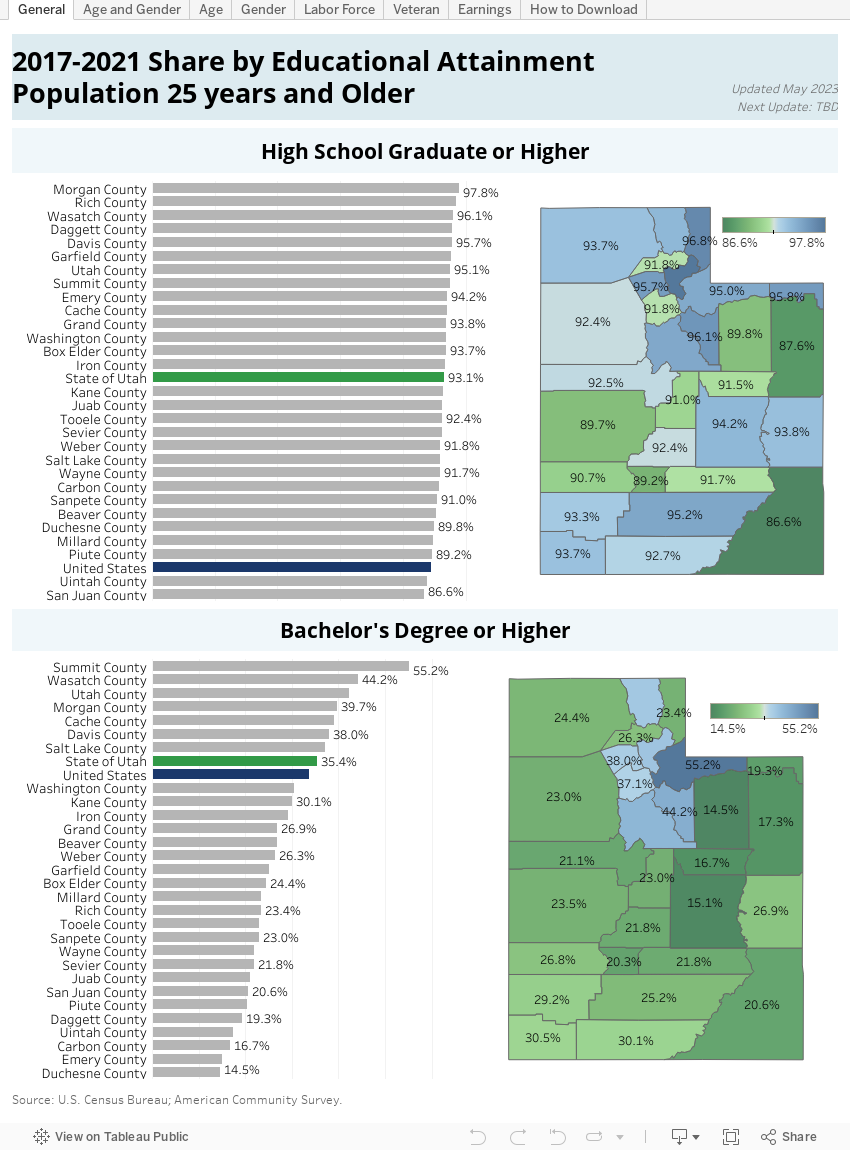

The American Community Survey (ACS) is a statistical survey administered by the U.S. Census Bureau. It regularly gathers information previously contained only in the long form of the decennial census, such as educational attainment, income and housing characteristics by age and sex. Sent to 3.54 million addresses annually, it is the largest survey (other than the decennial census) that the Census Bureau administers.

The ACS offers insights how the country’s workers of varying educational attainment are distributed and how they are compensated.

As a point of reference, on average, U.S. workers who possess less than a high school diploma earn $19,954. High school graduates earn $27,868. Workers who earned an associate’s degree or attended college earned $33,988. College graduates earn $50,515. Recipients of graduate degrees make $66,944.
Nationally, men make more than women. For example, women earn between 32 and 34 percent less than males with equivalent educational background. Some, but not all, of this difference can be explained by a significant proportion of women who choose part-time employment.

The ACS also maps the composition of the labor force by highest educational attainment. Nationally, roughly 12 percent of the 25-year-and-older population has not graduated from high school. Almost 27 percent of the population has a high school diploma while 31 percent has advanced to an associate’s degree or has attended university. A little more than 30 percent has a bachelor’s degree.

What follows is a comparison of the population of the counties in the Southeast Region against the national statistics.

Grand County

On average, Grand County residents who possess a high school diploma earn $31,396. Workers who have earned an associate’s degree or attended college earn $23,051. College graduates earn $31,174. The reader should regard these median income statistics with some skepticism; analysts speculate that they are a product of large sampling errors. Holders of graduate degrees substantially out earn bachelors, $53,000 compared to $31,174.

Workers in Grand County earn 70 percent of the U.S. median. With respect to gender, women in the county earn 65 percent of men’s wages, while the analogous U.S. figure is 72 percent; however, these figures are suspect. This is evidenced in the ACS reports that women with less than a high school education earn 195 percent of the equivalent man’s income, while women who hold bachelor’s degrees only make 37 percent.

High school graduates in Grand County earn 113 percent of the U.S. median. Men earn 104 percent of the U.S. median for men, while women earn 106 percent of the U.S. median for women. Grand County residents who hold an associate’s degree or have attended college make 68 percent of the U.S. average. Men earn 61 percent of the U.S. median, while women earn 66 percent. College graduates in Grand County make 62 percent of the U.S. median. Men earn 66 percent of the U.S. median for men; in contrast, women earn only 32 percent of the U.S. median for women. Recipients of graduate degrees earn 79 percent of the U.S. median. Men make 65 percent, while women make 60 percent of their respective median.

Grand County’s population differs from the U.S. by educational attainment. Almost 43 percent of the county’s population reports holding an associate’s degree or having attended college — the national number is 31 percent. Only 22 percent of the county’s population holds at least a bachelor’s degree — the national figure is 31 percent.

San Juan County 

San Juan County who possess less than a high school diploma earn on average $18,906. High school graduates earn $24,705. Workers who have earned an associate’s degree or attended college earn $28,333. College graduates earn $41,354. Recipients of graduate degrees make $49,694.

Workers in San Juan County earn 82 percent of the U.S. median. With respect to gender, women earn 60 percent of men’s wages, while the analogous U.S. figure is 72 percent. It is interesting to note that women in San Juan County with college educations perform better than their national counterparts. Women with bachelor’s degrees earn 72 percent of their male counterparts’ income, while women who hold graduate degrees earn 90 percent of their male coworkers’ income. High school graduates in the county earn 89 percent of the U.S. median. Men earn 97 percent of the U.S. median for men, while women earn only 64 percent of the U.S median for women. San Juan County residents who hold an associate’s degree or have attended college make 83 percent of the U.S. median. Men earn 92 percent of the U.S. median, while women earn 81 percent of their respective statistic. College graduates in San Juan County make 81 percent of the U.S. median. Men earn 72 percent of the U.S median for men; in contrast, women earn 77 percent of the U.S. median for women. These statistics are suspect due to large sampling error. Recipients of graduate degrees earn 74 percent of the U.S. median. Men make 64 percent of the median; surprisingly, women make 86 percent of the median for women with graduate degrees.

San Juan County’s labor demographics differ markedly from the nations because of participation rates and educational attainment. For individuals with less than a high school education, more than 7.9 percent of the county population is not in the labor force — the U.S. number is 4.7 percent. More than 15 percent of county residents with a high school diploma do not participate in the labor market. The analogous national number is a little more than 7 percent. The county also has less college graduates than the nation as a whole — 19 percent of the county’s population possesses a bachelor’s degree of higher (the national figure is 31 percent).

Thursday, September 4, 2014

Long-Term Employment Projections

The long-term employment projections have been updated for the time period of 2012 to 2022. Projections are produced for the state of Utah as well as for eight sub-state areas. The areas are determined by population and job density and are not created equal. But rather, types of jobs are determined by the nature of the local area’s economy. Short-term projections for 2012 to 2014 are also provided for statewide.

The value in providing these projections is to help identify which types of jobs are most likely to be in high demand in the future. Ultimately, the long-term employment projections act as a forecasting measure by which individuals as well as organizations and agencies can plan ahead.

See the latest long-term projections produced by DWS for the Eastern Utah area.

Friday, August 29, 2014

A Story of Wage Data

The Wages and Income page has a new look to the wage data that is gathered by the Workforce Research and Analysis division. Along with visualization of the data, you can now read story points at the top of each graph, to help understand what the data is showing you along with highlighting its insights. Just click along the story points at the top of the visualization to follow the story of wages.


Monday, October 29, 2012

New Student Housing Underway at USU Eastern Blanding

The recent dedication of USU Eastern’s Blanding Campus Administration Building was done with the rumbling of heavy equipment in the air. Excavation is already underway for new and much-needed housing on the 600-student campus.

Front-end loaders are carving out a site that will eventually room up to 74 students and more than double housing capacity on the 150-acre campus of Utah State University-College of Eastern Utah. Plans are to start moving students in by spring of 2013. And it can’t come soon enough, said Kol Conway, housing and food services director.

The campus has experienced a housing overflow for the past four years. Early on it began to reach out to local motel owners to house students in their rooms.

USU Eastern uniquely draws some 65 percent of its student body from the nearby Navajo Reservation. “We have reached our capacity,” Wilson said. “Parents want their children to be able to live on campus, and we want them to be able to as well. There is tremendous value, particularly with freshmen students, having a positive campus life experience.”

Wilson said the campus has exceptional facilities and resources. Students who are able to live on campus stand the most to benefit from those offerings. And word has gotten out as the waiting list continues to grow.

The 17,200-square-foot building will break from tradition and consist, instead, of suites, common areas and kitchenettes. Housing units will either contain three or four bedroom units with two students per bedroom. Private room suites will also be available, Conway said. San Juan Record

Friday, August 3, 2012

Return on Knowledge in the Southeast Service Area - Local Insights article

Benjamin Franklin once said, “If a man empties his purse into his head, no one can take it from him. An investment in knowledge always pays the highest return.” For this inaugural issue of Local Insights, the Department of Workforce Services (DWS) decided to analyze the Southeastern region of Utah’s economy through the lens of education. When approaching an analysis like this, the usual questions instantly came to mind: Do more highly educated people necessarily make more money? What does the education profile look like for the various industries in the Castle Country and Southeast regions of Utah? Which industries employ the highest proportion of degreed workers? The aim of this article is to answer these and other questions, which will hopefully allow us to gain some interesting insights into the educational profile of the East-Southeast as well as the effects of education on workers in the area. As the article progresses, “Southeast” will refer to Carbon, Emery, Grand and San Juan counties.

Read more>>

Thursday, April 26, 2012

School District Negotiating Employment Contracts

The compensation package for San Juan School District personnel was put on hold during the April 17 meeting of the school board. The offer presented by the district had not yet been agreed to by the San Juan Education Association at the time of the meeting, therefore the board scheduled a special meeting on May 1 to give more time to the association.

At the time of the meeting, it was reported that just 30 percent of the membership had responded to the offer, of which 20 percent had voted no to the offer presented by the District. District Business Administrator Clayton Holt said that once the teachers understood the options, he thought they would vote for the change.

Major changes in the offer proposed by the District was to freeze all step increases and give an across-the-board salary increase of 1.5 percent. Currently employees move up the “steps” based on years of service. Many of the employees have reached the maximum step increase allowed based on their years of service with the district and haven’t had a pay increase in several years.

Another major change would involve the health care package changing from the silver option to the bronze option. Employees would have the choice of upgrading to the silver or gold package at their own cost.  San Juan Record

Thursday, March 8, 2012

New admin building on campus in Blanding

The just-completed Utah State University – Eastern Administration Building in Blanding is the culmination of creative solutions and innovation that distinguishes this can-do campus of 400 students. Completion of the new 5,070-square-foot building, is a tribute to the leadership and vision of many individuals that stretches back to 1982, said USU Eastern Chancellor Joe Peterson. The new administration building is a well-appointed structure with professional spaces and amenities. It includes 12 individual office spaces, two conference rooms, workspace and reception areas. The larger of the two conference rooms will accommodate medium-to-large meetings, and will be made available to community groups. San Juan Record