Showing posts with label Region--Southeast. Show all posts

Tuesday, June 2, 2020

Unemployment Insurance Claims Data Shed Light on the Local Economic Impacts of COVID-19 Public Health Directives


By Lyndsey Stram, Regional Economist; Lecia Parks Langston, Senior Economist

“You have power over your mind — not outside events. Realize this, and you will find strength.” Marcus Aurelius

In the wake of the COVID-19 pandemic, businesses lost revenues and workers lost jobs. But because of the time it takes to collect and collate data, economists have been left without much information to quantify the economic impacts at the local level.

But there is one ray of data illumination. Claims for unemployment benefits are promptly available and provide information about a large cross section of the economy. This post will outline what light unemployment claims data sheds on the state of southeast Utah’s economy.

While not all workers are protected by unemployment insurance laws, roughly 95% of jobs are covered. This makes claims data an exceptional source of information about the economy. Not included under unemployment insurance laws are most self-employed workers, about half of agricultural employment, unpaid family workers, railroad personnel (covered separately) and many nonprofit organizations (such as churches). Also, some out-of-work employees may not have worked a sufficient work history to qualify for unemployment insurance benefits, but may file anyway.

Fortunately, in this time of economic distress, the social safety nets of the unemployment insurance program, special national COVID-19 funding and social programs are working together to keep workers’ income and well-being stable.

Unemployment claimants and the unemployed; they aren’t the same

Also, keep in mind that, in addition to individuals drawing unemployment benefits, the unemployment rate includes those entering and re-entering the workforce and non-covered groups without current employment. This means the number of “unemployed” will be greater than the number of claimants. In “normal” times, only about 40% of the “unemployed” are claiming benefits.

The generally reported unemployment rate also has a work-search requirement. If you haven’t made any minimal attempts to find work, you aren’t counted as “unemployed.”

Watch this Space

While this analysis won’t be updated on a regular basis, new data will be added to the data visualization on a weekly basis allowing readers to check back for the latest information.

An Unprecedented Event

Not surprisingly, first-time claims for unemployment benefits soared in Utah and across the nation as the pandemic swept across the country. This increase is unprecedented since the creation of unemployment insurance coverage during the Great Depression. Week 12 (beginning March 16) marks the start of this unparalleled surge in claims. On a positive note, while new claims for unemployment insurance have skyrocketed in Utah, the state currently shows one of the lowest claims rates in the nation.

Most counties in the state saw the peak of first-time unemployment claims in weeks 13 and 14, 1-2 weeks after the COVID-19 pandemic hit, and this was true of San Juan County. Grand County however, with its large majority share of unemployment dependent on tourism related industries, saw a peak right away in week 12.

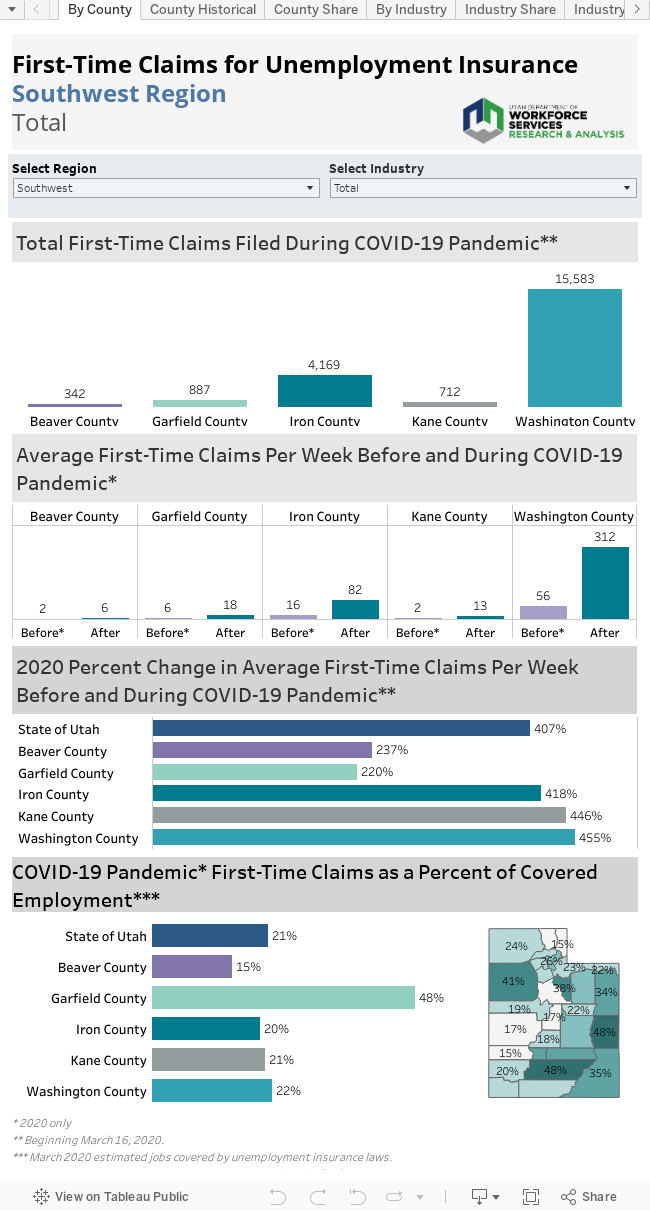
Another way to note the unprecedented flood of new claims is to look at weekly averages. Prior to the COVID-19 pandemic, southeast Utah averaged 23 claims per week. This has since increased to 227 average weekly first-time claims for unemployment.

Who took the hardest hit?

Counties with economies that largely depend on tourism are feeling the greatest economic and employment shocks in the state. This is true of Grand County, where 22% of the covered workforce has filed a claim for unemployment insurance in the weeks since the COVID-19 pandemic hit. San Juan also has some dependence on tourism but has only seen 11% of its workforce file, in line with the state average.

Tourism and COVID-19

Especially in the early stages of the restrictions, this is a story of tourism-dependent industries. More than 38% of COVID-19-related initial claims filed in southeast Utah represented workers previously employed accommodations and food services. In addition, the true effect of the pandemic on this industry is masked by a large number of claims classified as industry “unknown” in the early days of the claims flood. Undoubtedly, many of these claims would rightfully be classified in accommodations/food services if the appropriate information were available.

The High and the Low

Although accommodations/food services has generated the largest number of southeast Utah initial claims in the COVID-19 time period, in percentage terms, other industries have actually suffered more. For example, in the extremely small management of companies industry, roughly 70% of workers have filed for claims. The administrative support/waste management/remediation industries, which include temporary employment firms, shows a first-time claims rate of 52%.

Public administration however, has held onto higher portions of its workforce. Only 9% of the covered workforce in that sector have recently filed claims for unemployment. This is positive for southeast Utah where a large portion of the workforce is employed in this sector.

In many areas, healthcare/social assistance has made up for a large share of claims with the cessation of elective medical services. Southeast Utah has not seen this effect and much of that sector has remained employed.

County by County

Grand County
Prior to the COVID-19 pandemic, Grand County saw a weekly average of 13 first-time claims for unemployment. In the weeks since, this has increased to 169 average weekly claims.
Spring generally brings the start to the busy tourism season in Grand County, making the timing of the restrictions particularly impactful to the area. Nearly 500 claims (and probably well over if there was complete information for the unknown industry claims) were filed by workers previously in the accommodations/food services sector. Arts/entertainment/recreation also accounts for nearly 100 claims.
Transportation and warehousing are also important to Grand County. About 25% of the workers from that sector have also filed claims for unemployment insurance in the wake of COVID-19.
Before COVID-19 restrictions were enacted, Grand County made up for 57% of the region’s unemployment claims. This has since increased to 75%.

San Juan County
Prior to the COVID-19 pandemic, San Juan County saw a weekly average of 10 first-time claims for unemployment. In the weeks since, this has increased to 58 average weekly claims.
Although less dependent than its neighbor, Grand County, San Juan also depends on tourism spending during the summer months. Accommodations/food services accounts for the large majority of the first-time claims for unemployment in the county. As a percentage of the covered workforce in that sector, 23% of workers have filed.
Public administration is an important sector in San Juan County and a sector that has not yet seen major shocks from the pandemic. Only 3% of this large industry has filed claims in recent weeks.
Before COVID-19 restrictions were enacted, San Juan County made up for 57% of the region’s unemployment claims. This has since decreased to 25%.

Wednesday, November 4, 2015

Reviewing the 2012 Agricultural Census for the Southeast Region

Scott Smith, Regional Economist


The 2012 Census of Agriculture is just that — a census. It is an attempt to count an entire population and generally does not use sampling or statistical techniques to make conclusions about the population. It is conducted every five years and includes all farm operators regardless of whether farming is their primary or secondary occupation. Operators and hired laborers are combined for a total count. There can be a maximum of three operators per farm, but labor hired on a contract basis is not covered.

The Southeast Region agriculture is largely devoted to the livestock business, this by raising cattle or growing hay. There is also some wheat farming worth noting in San Juan County. 2012 net cash income per farm for Grand County was -$3,725. The analogous figure for San Juan County was -$1,522. The vast majority of farms have annual total sales less than $250,000.

Southeast Region 2012 employment was 1,679 jobs according to the census (this number may slightly differ from other data presented because of confidentiality issues). The state’s unemployment insurance data suggests that a very small number of these jobs generate the income or possess the duration to be considered “full time” employment in the urban sense. Further data indicates that most farmers and ranchers are sole proprietors (regardless of how they are organized for tax purposes). Finally, a comparison of the other sources and the census figures shows that most individuals involved in agriculture have their primary job in other sectors of the economy.

The size and composition of the agricultural workforce has changed markedly over time. In 2002, the total Southeast Region agricultural workforce was 839 workers, of which 40 percent was hired labor. That total increased by 112 percent to 1,776 in 2007, yet the share of hired laborers fell to 16 percent in the same period (although this statistic may be skewed downward because of reporting issues). In 2012, the agricultural employment count fell 5 percent to 1,679 and the share of hired labor increased slightly to 20 percent.

In 2002, the labor cost per worker (as defined by dividing annual labor expense by the hired workforce) was $1,270. In 2007, the cost had fallen by 33 percent to $850. In 2012, this number had increased by 15 percent to $980. In contrast, inflation increased by 15 percent and 9 percent as of 2007 and 2012, respectively.

There were 325 principal operators in the Southeast Region in 2002 (the statistics refer to “principal” operator and therefore will not agree with other totals). The number of operators increased to 848 in 2007, which is an astounding 161 percent increase. The count dropped slightly to 827 in 2012. The share of operators relying on other sources of employment has been remarkably constant. In 2002, the proportion was 41 percent. It dropped slightly to 40 percent in 2007. The share then increased to 46 percent in the 2012 Census.

Analysts are unable to convincingly explain the employment patterns with income statistics. One would expect to observe the number of operators falling in concert with the decline in income. Similarly, one should expect that operators would seek other sources of employment when income declines. Farm income per operator was $2,723 in 2002, and then decreased 300 percent to -$2,085 in 2007. In 2012, income per operator declined another 19 percent with a total of -$1,738.


Monday, April 27, 2015

Grand County Economic Update

Tyson Smith, Regional Economist

The Utah Department of Workforce Services (DWS) relies on several data sources to help describe the state of the economy. The most accurate data available is the nonfarm payroll employment information that is collected through the Quarterly Census of Employment and Wages. However, the resources required to gather data accurately come at the expense of timeliness, which results in a four to six month lag between the time these data are collected and when they are available to the public.

Other data are collected in a timelier manner, and these data (along with historical trends) provide a foundation to estimate current economic conditions. Economists at DWS rely heavily upon statistical models, surveys, and limited datasets to evaluate the economy in real-time. Some of those tools, like the county unemployment rates and initial weekly unemployment claims, are highlighted in this article.

The truth is that no single source of economic data exists that can appropriately profile the labor market in real-time. So, when evaluating regional economies it is important to understand the recent economic history of the area, while also using any up-to-date information available despite the limitations of present data.

Tuesday, February 10, 2015

Grand County Economic Update

Regional payroll employment shrinks slightly in the third quarter

Tyson Smith, Regional Economist

Broad-based economic growth does not always portend positive economic conditions in every community. Utah has seen significant labor market expansion over the last four years, growing at an annual rate of about 3 percent since 2011. And yet, economic recovery in the Southeast region has been less than consistent.

The two counties in the Southeast region – Grand and San Juan – have moved in opposite directions since 2011. Grand County has been consistently adding employment over the last four years except for a brief period in 2013. San Juan County has consistently shed employment during the same period, except for a nine-month window from mid-2013 to early 2014. 

Grand County
  • Grand County has been the exception among the Castle Country and Southeast counties in terms of payroll employment growth. The 2.9 percent year-over job growth in third quarter 2014 was above the state average, and the county has been consistently adding employment since July of 2013. On average, the county added 158 jobs from third quarter 2013 to third quarter 2014. The educational/health/social services and professional services industries were the big contributors, adding 70 and 46 employees, respectively. 
  • The recent momentum in the county’s labor market has had a dramatic effect on the seasonally adjusted unemployment rate, which has fallen from 7.1 percent in December 2013 to 5.7 percent in December. However, the 5.7 percent represents an upturn since September, and is still notably higher than the Utah average (3.5 percent). 
  • The recent rise in the county’s unemployment rate is not reflected in the initial unemployment claims data. The number of initial weekly claims filed in the fourth quarter of 2014 was down 23.5 percent from 2013. Given the underlying trend of initial claims, the unemployment rate may stabilize in the short term.
  • As the labor market continued its momentum in the third quarter of 2014, so did average wages in the county. Year-over average monthly wages grew 2.8 percent – or 1.3 percentage points faster than the Utah rate. The service-producing industries saw the largest increases, most notably in leisure/hospitality which increased average monthly wages 4 percent.
  • Third quarter 2014 taxable sales in Grand County rose by 13.3 percent from 2013, the third largest increase in the state. Accommodation and mining sales increased more than any other industries in the county, improving $4.8 million and $1.3 million, respectively, from third quarter 2013. 
  

San Juan County Economic Update

Regional payroll employment shrinks slightly in the third quarter

Tyson Smith, Regional Economist

Broad-based economic growth does not always portend positive economic conditions in every community. Utah has seen significant labor market expansion over the last four years, growing at an annual rate of about 3 percent since 2011. And yet, economic recovery in the Southeast region has been less than consistent.

The two counties in the Southeast region – Grand and San Juan – have moved in opposite directions since 2011. Grand County has been consistently adding employment over the last four years except for a brief period in 2013. San Juan County has consistently shed employment during the same period, except for a nine-month window from mid-2013 to early 2014.

San Juan County
  • San Juan County’s employment growth continued to erode in the third quarter of 2014.  The county shed a quarterly average of 47 jobs from third quarter 2013 to third quarter 2014, or approximately 1.1 percent. This marked the second consecutive quarter of year-over job losses. The goods-producing industries – down 11.9 percent – accounted for the majority of the job losses. Mining employment fell 14 percent, which represents a quarterly average of 53 fewer jobs.
  • As job growth stagnated in the county, unemployment remained relatively high. The rate settled at 8 percent in December (up from 7.8 percent in August), which is the third highest among Utah’s 29 counties. San Juan County’s unemployment rate is still markedly higher than both the state and national averages.   
  • Fourth-quarter initial unemployment claims paint a more optimistic picture. During the last three months of 2014 the average number of initial weekly unemployment claims fell 24.6 percent from the same time last year. On the other hand, the first few weeks of 2015 show signs that the positive trend may be reversing as initial claims have risen by an average of five claims per week (up 53.2 percent from 2013).
  • Average monthly wages in the county also declined slightly. Weakening in the service-providing industries, particularly retail trade and government contributed to falling wages. 
  • Third quarter 2014 taxable sales in San Juan County fell 17 percent from third quarter 2013. The county experienced a drop in year-over taxable sales growth for the fourth time in the last five quarters. Taxable sales in mining/quarrying/oil and gas extraction fell by $3.5 million, more than any other industry. 
  

Wednesday, July 17, 2013

Arena poised for even bigger economic and recreational roles

While contending that the Old Spanish Trail Arena (OSTA) is already an economic boon to the community, arena manager Steve Swift says he hopes recent and future improvements will bring even greater benefits to area residents.

The OSTA hosted some 23 events last year, Swift said, adding that he didn’t count the ongoing non-paid use by winter indoor soccer leagues. Although the paid events in 2012 generated only about $16,000 cumulatively in arena rental fees, Swift said the facility’s benefit to the community is much greater.

Monday, June 17, 2013

Cache Valley Bank acquires eight branches in central, southern Utah

Logan-based Cache Valley Bank will acquire eight AmericanWest Bank branches in central and southern Utah, with the transaction expected to be completed in the third fiscal quarter of this year.

The banks have entered into a definitive agreement, and the acquisition is subject to regulatory approval and all other customary conditions of closing. The branches included are Price, Fairview, Mt. Pleasant, Nephi, Loa, St. George and two in Ephraim.

The sale will also allow AmericanWest Bank to reshape its service area in Utah, focusing on serving the communities along the Interstate 15 corridor from North Salt Lake to Utah County, according to a joint news release. Herald Journal

Monday, June 3, 2013

BLM seeks changes in hydraulic fracking rules

The U.S. Bureau of Land Management’s (BLM) revised proposed rule covering hydraulic fracturing is raising concerns among industry representatives. The rule would apply to hydraulic fracturing, or “fracking,” on federal and Indian lands.

Fracking is the process of injecting rock formations with pressurized liquid to release petroleum or natural gas for extraction. The U.S. Environmental Protection Agency is studying fracking to understand potential impacts on drinking water and groundwater. One of the BLM proposal’s key issues centers on identifying chemicals used in the fracking process. There’s a chance industry officials might contend a few the chemical compositions constitute a trade secret and should not be disclosed, according to BLM spokeswoman Bev Winston of the agency’s Washington, D.C., office. Times-Independent

Thursday, May 16, 2013

Moab‐Salt Lake bus route on hold

Last year Pocatello, Idaho-based shuttle service Salt Lake Express won a federal grant to provide twice-a-day shuttle service from Moab to Salt Lake City, with stops in Price and Blanding.

But the funding has been withdrawn because the company did not meet requirements outlined in the Americans with Disabilities Act (ADA), according to Kathy Pope, sales grant manager for Salt Lake Express.

Utah Department of Transportation spokesman Kevin Kitchen said it’s an unfortunate situation. Salt Lake Tribune

Related post

Monday, May 6, 2013

Hinto Energy acquiring additional wells and 4,400+ acres in Utah

Hinto Energy reported on Wednesday the Company has entered into a letter of intent to acquire a 100% working interest in 9 natural gas wells and in excess of 4,400 gross leased acres in the Cisco Springs oil and gas field, in the Uintah Basin of Grand County, Utah. The company is planning to connect the well into the local gas gathering system, as soon as proper testing and evaluation is completed. They expect to complete the acquisition in May of this year. Fairfield Sun Times

Tuesday, March 19, 2013

San Juan Highlights

San Juan county remains one of the counties hit hardest by the recent recession. Total nonfarm employment year-over growth has been negative in San Juan county since the summer of 2011. San Juan county’s total employment for third quarter 2012 fell by 111 jobs, a 2.6 percent year-over-year decline. Recovery has been tough for this corner of the state, but there were some bright patches during the third quarter.

Professional and business services added 37 jobs in the third quarter compared to the same quarter of 2011, representing a 22.8 percent increase. Educational, health and social services also grew by 8.9 percent, or 50 jobs. Construction, accommodation and food services, and retail were some industries that saw the biggest third quarter declines in terms of employment. Government, too, shed 46 jobs.

Construction data from the Bureau of Economic and Business research at the University of Utah tells the same story. Construction is stalled as dwelling permits are at 4 percent change year-over-year and permit-authorized construction values dropped 4 percent year-over-year. Also, taxable sales data from the most recent Utah state tax commission report shows consumer spending is actually up 17.5 percent.

Read more about San Juan and Southeast Utah including the Castle Country area in the latest issue of Southeast Local Insights.


Access San Juan’s county eProfiles here: San Juan eProfiles

For more county eProfiles, see here

Wednesday, February 27, 2013

Moab businesses prepare for busy tourism season

Moab is putting on a fresh face for the upcoming tourism season with some local businesses renovating their decor, others are expanding and several new shops and restaurants opening.

The Best Western Greenwell Inn and Eddie McStiff’s have both been remodeled, and Slickrock Café received a new coat of paint along with new dishes and appetizers.

The new Essential Home store opening in March will offer kitchen utensils along with wine, tea and coffee accessories and souvenirs.

Twisted Sistas’ Cafe will join the ranks of Moab eateries with its grand opening Friday, March 1.

Scarlet Rox Salon and Lash Works will be opening next month offering haircuts, coloring, waxing, sculptured acrylic nails, eyelash extensions, shampoo sets and shaves.

Moab also will have another Mexican restaurant this year. Los Dos Amigos will be located at 2728 S. U.S. 191. Moab Times-Independent

Wednesday, February 20, 2013

Utah to get $900K federal grant to connect parks

Utah is set to get $900,000 in federal funds for the construction of a pathway to connect Moab to surrounding national parks and public lands in the eastern part of the state.

U.S. Secretary of Transportation Ray LaHood announced the grant Monday as part of $12.5 million in federal money to improve access to national parks, forests and wildlife refuges.

A U.S. Department of Transportation statement says the grants will go toward 29 projects in 20 states.

Utah's share will go to Grand County to fund the continued construction of the Colorado Riverway Path. The pathway will join Moab with Arches and Canyonlands National Parks, the Colorado Riverway Recreation Area and other lands. Daily Herald

Monday, February 11, 2013

Some employment seekers strike gold at Moab job fair

Many swarmed the Moab Arts and Recreation Center on Wednesday seeking employment from about two dozen companies and agencies that had set up booths. The annual event ran from 8 a.m. until noon.

There were jobs to be had, too. Some applicants struck gold during the job fair’s first two hours.

“Everyone is hiring within the next month or so,” said organizer Kelly Thornton, workforce development specialist with the Utah Department of Workforce Services. “Our employers have reported good applicants and some jobs have already been offered.”

Blu Pig owner Penny Tanner planned to hire 30 people for part-time or full-time work. The jobs included cooks, servers, food runners, dishwashers, food prep specialists, bartenders, hostesses and table bussers.

With tourist season kicking off the first of March, Tanner said there’s no time to waste. She listed the available positions on a blackboard next to her booth.

The Grand County job market has improved in the last couple of years, according to information from the Utah Department of Workforce Services. The agency’s website shows the county’s unemployment rate was 8.7 percent in 2012, down from 9.8 percent in 2011, 10.7 percent in 2010 and 10.3 percent in 2009.

Moab City Economic Development Specialist Ken Davey said economic growth has been steady but nothing major.

Davey noted that some hotel firms plan expansions in Moab and he called that an encouraging sign. Moab Times

Friday, February 1, 2013

DWS to host Job Fair February 19, 2013

The Utah Department of Workforce Services in partnership with San Juan County Economic Development is sponsoring a job fair in Blanding on February 19, 2013 from 2:00 P.M. to 6:00 P.M. It will be held at the Blanding Arts and Events Center located at 715 West 200 South, Blanding.

Participants are asked to register with DWS to gain admittance to the job fair. Early Registration can be done by going to the Blanding Employment Center.

Employers that wish to participate can contact Kelly Thornton by email kthornto@utah.gov or telephone (435) 719-2630. Department of Workforce Services

Thursday, January 31, 2013

Olene Walker Housing Loan Fund Board Approves Funding for 497 Affordable Housing Units in Utah

The Olene Walker Housing Loan Fund Board approved $6,933,092 in low interest loans for housing projects throughout the state of Utah during a funding meeting held here on January 24.

Salt Lake County will be home to many of the approved projects, other projects will be constructed in Grand and Weber Counties. Department of Workforce Services

Daily bus service coming to Southeast area


Twice daily bus service from the Wasatch Front to San Juan County will begin in April. Salt Lake Express Bus Service will offer transportation that initiates in Blanding and terminates at the Salt Lake International Airport.

The service will offer connections with Greyhound Bus Service in Green River and the Wasatch Front, in addition to links for Amtrak, airports, major hospitals and bus service into Idaho, Wyoming and Montana.

Pope said that a Utah Department of Transportation study identified two big gaps in bus service in Utah, including routes into southeast Utah and into Sanpete and Sevier counties. The company will open both routes in coming months.

Reservations are required to use the service and can be made online or by telephone. Pope said the company operates full-sized coaches on other routes but expects to operate 16-passenger vehicles to the area until ridership grows. San Juan Record

Friday, January 25, 2013

DWS to host Job Fair February 6, 2013

The Utah Department of Workforce Services is sponsoring a job fair in Moab on February 6, 2013 from 8:00 A.M. to 12:00 P.M. It will be held at the Moab Arts and Recreation Center located at 111 East 100 North, Moab.

Participants are asked to register with DWS to gain admittance to the job fair. Early Registration can be done through the internet at jobs.utah.gov or by going to the Moab Employment Center.

Attendees who register at the employment center are asked to bring a prepared master application or
résumé. Employees can assist those who do not have a résumé, as well as, offer help with strategies for approaching employers. An express admission to the job fair will be provided to those who come into the employment center.

Registration will be accepted at the door when participants show their prepared master application or
résumé in hand.

Employers that wish to participate can contact Kelly Thornton by email kthornto@utah.gov or telephone (435) 719-2630.  Department of Workforce Services

Thursday, January 17, 2013

City OKs smaller residential lot sizes

The Moab City Council has given final approval to an ordinance allowing home construction on smaller lots.

Approved by a 4-1 vote Tuesday night, the ordinance allows minimum lot sizes of 5,000 square feet rather than the previous 7,200 square feet. It also reduces the maximum height of new homes from 40 feet to 30 feet.

Council members characterized it as a way to provide affordable housing within city limits. However, the issue became somewhat controversial over the past year, with some city residents saying during public hearings that the ordinance would negatively impact neighborhoods and possibly block solar access.

Council member Kyle Bailey explained during an interview that he is worried about the effects the ordinance will have on existing subdivisions. People who purchased homes in a neighborhood did so expecting a certain look, Bailey said. But homeowners are free to expand their houses under the revised ordinance, altering the appearance in a way other residents might not like, he said.

The ordinance goes into effect immediately for new residential construction, Peterson said.
Moab Times-Independent

Thursday, January 10, 2013

USDA Designates 597 Counties in 2013 as Drought Disaster Areas – Seventeen in Utah

Source: USDA
Agriculture Secretary Tom Vilsack today designated 597 counties in 14 states as primary natural disaster areas due to drought and heat, making all qualified farm operators in the areas eligible for low-interest emergency loans. These are the first disaster designations made by the U.S. Department of Agriculture in 2013.

The 597 counties have shown a drought intensity value of at least D2 (Drought Severe) for eight consecutive weeks based on U.S. Drought Monitor measurements, providing for an automatic designation. The Drought Monitor is produced in partnership by USDA, the National Drought Mitigation Center at the University of Nebraska-Lincoln, and the National Oceanic and Atmospheric Administration. It helps USDA determine county disaster designations due to drought. The Drought Monitor measures drought intensity on a scale from D1 to D4, as follows:

D1: Moderate Drought
D2: Severe Drought
D3: Extreme Drought
D4: Exceptional Drought

Visit www.usda.gov/drought for the latest information regarding USDA’s drought response and assistance, and http://droughtmonitor.unl.edu/DM_state.htm?UT,W for information on Utah. Southeast AgNet